Your Voice Matters
At the CBE, every voice matters. That’s why we’ve developed a community engagement framework, called Dialogue.
We are committed to involving people in decisions that affect them. Your perspectives help us to make the best decisions for students.
Opportunities to provide input and feedback may involve multiple communities and happen at a system level. Other decisions may happen at a school level. Regardless of who is making the decision, all CBE community engagement activities are guided by the Dialogue Framework.
Other community engagement initiatives happen at the school level. You can find out more about school-based engagements by visiting your school's website.
Active Engagements
2024-2027 Education Plan Year 2 Check-in Survey
From Feb. 23 - Mar. 8, 2026, the CBE gathered feedback from staff and families to better understand how the 2024-2027 Education Plan is progressing toward its goals.
The results help inform updates and refinements for year three of the current plan.
School Planning Engagement
Each year, schools invite families to share feedback on the school development plan, school budget, and school fees.
This input plays an important role in supporting student learning and strengthening school planning.
From February to March, schools will share upcoming opportunities for parents and guardians to contribute their thoughts and ideas.
Watch the video to learn more about school planning.
Watch the videoWhat Are the Guiding Principles of Dialogue?
Dialogue follows international standards of public participation (IAP2) in decision-making. It is also guided by these fundamental principles.

Inclusive
Preferences for engagement and communication are considered and barriers are addressed wherever possible.

Honest
Listening and communicating in a clear, candid and forthright way.

Accountable
Making the best decisions for students.

Mutual Respect
Roles are understood and participants are open, respectful and cooperative.

Responsive
Participants are provided with appropriate information in a timely way that allows them to provide meaningful input.
What are Some Common Myths about Dialogue?

Myth
The Loudest Voice Wins.

Truth
It is important to consider all perspectives, not only the views of people with the loudest voice.

Myth
Those participating in the engagement have decision-making authority.
Truth
All input and feedback will be considered, but the CBE is responsible for the final decision.

Myth
It’s a vote.
Truth
Input and feedback is one of multiple factors that may influence decision-making. It is not the only consideration.
To Engage or Not to Engage? That is the Question.
Some situations require community engagement while others do not. Sometimes the distinction between community engagement and communication can get blurry, which is why the first step of the Dialogue process should involve a thorough assessment of the situation.
Engagement is needed when these are both true:

There is a decision to be made.

There is an opportunity for those affected to influence the decision.
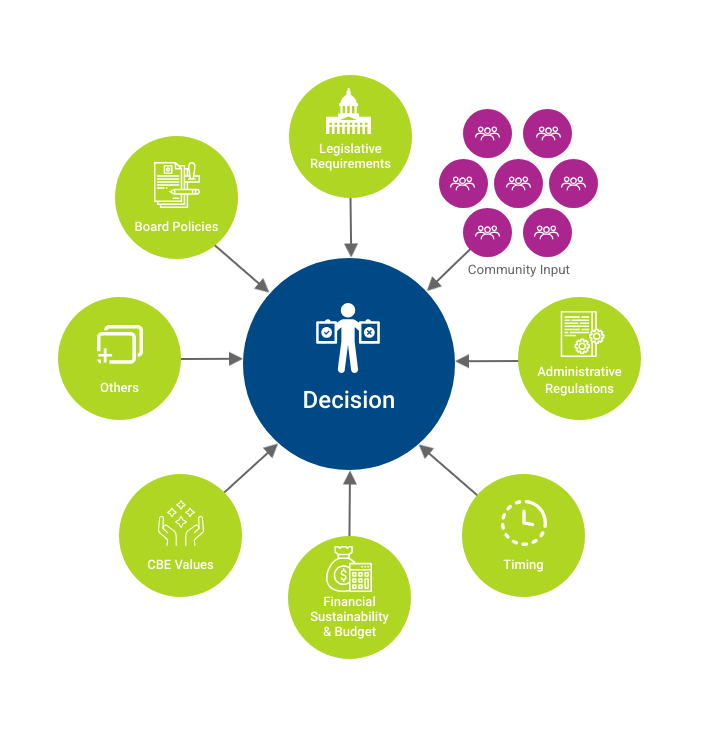 How is Input Considered in Decision-Making?
It’s important to identify which aspects of a decision people can influence and which they cannot. We refer to this as defining the scope of the engagement. The scope of the engagement is always smaller than the scope of the decision because, along with the input gathered, many other factors must be considered before making a decision. It is often not possible for people to influence all factors related to a decision. The diagram below shows some of the factors that are considered when the CBE makes a decision.
What Are the Dialogue Levels of Engagement?
At the CBE, every engagement initiative starts with a commitment to involve people in the decisions that affect them. Each project is different and is assigned a level of engagement based on the impact of the decision and the influence people can have. Below, are the CBE levels of engagement and our corresponding commitment.
There may also be instances when there is a decision to be made and people can influence the decision, but community engagement will not be an effective or productive means of decision-making. This includes situations where two communities would be pitted against one another or situations where the timeline for decision-making does not allow for adequate engagement.

Gather Input |

Work Together |

Assign |
|
|---|---|---|---|
| CBE Commitment | We will consider advice in a meaningful and transparent way. | We will co-create solutions to address problems and seize opportunities together. | To the greatest extent possible, we will implement your recommendations. |
|
Inform & Communicate: Every step of the way, we are committed to sharing, listening and learning to build mutual understanding and respect. |
|||
| What | CBE asks questions and the community shares their perspective. | The community and CBE collaborate to develop options in support of decision-making. | Based on clearly defined parameters, the community is assigned specific parts of the decision. |
| Why | To gather input in response to questions or alternative approaches. | The decision is complex and impacts the community. A high degree of understanding is required. | The level of impact is clear and there are opportunities for higher levels of engagement. |
| Example |
Symposium Focus Group Interview Online Workbook Crowd Sourcing |
Workshop World Café Charette Open Space Appreciative Inquiry Wiki |
Study Circle Future Search Advisory Committee Task Team Community Panel Community Jury |
For more information about the engagement process at the CBE, review the Dialogue Framework.
Contact
Dialogue
Last modified: 2026-08-12 07:23:23.967632 +0000 UTC